
SMR marketing promises cheap, fast, factory-built nuclear power. The actual cost data tells a more complicated story. Here’s what SMR facilities really cost, why early estimates keep climbing, and what the numbers look like once a project matures past first-of-a-kind status.
The SMR Facility Cost Calculator linked below is a great resource for both existing and new Small Modular Reactor businesses and investors. Use this free tool, built with real project presets, to estimate SMR capital costs and LCOE.
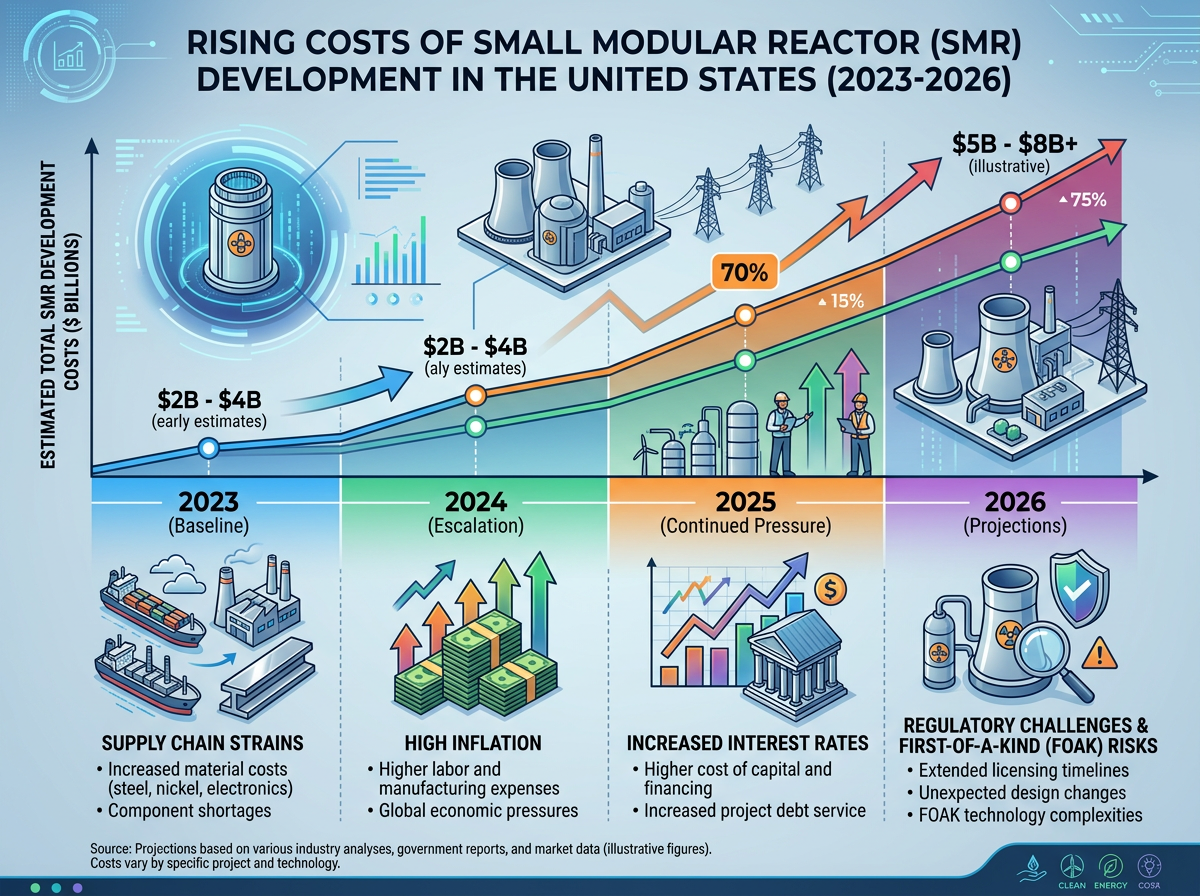
The Headline Number: Cost Per Kilowatt
Traditional large nuclear reactors currently run in the range of $7,700 to $12,500 per kilowatt of capacity. Independent industry estimates for advanced SMR designs — sourced directly from developers — put an average of roughly $3,800/kW across several proposed designs, with a couple of designs claiming under $2,500/kW.
Those numbers only hold up on paper. In practice, first-of-a-kind SMR projects have consistently landed far above their original estimates.
Case Study: NuScale’s Carbon Free Power Project
NuScale’s project with the Utah Associated Municipal Power Systems (UAMPS) is the most-cited case study in SMR economics, and it’s a cautionary one.
- Original estimate (2015): roughly $4,200-5,000/kW
- 2021 estimate: the target power price was $58/MWh, construction pegged around $5.3 billion for the 462 MW project
- 2023 estimate before cancellation: construction cost rose to $9.3 billion, pushing the per-kW cost to roughly $20,000/kW — in the same range as the Vogtle large-reactor project it was supposed to undercut
- Outcome: the project was cancelled in November 2023 after utilities couldn’t line up enough subscribers at the escalated price
The project never broke ground. All of that cost growth happened during planning and licensing, before construction even started — which is itself a signal for anyone evaluating SMR economics today.
Why Costs Climb: The FOAK Problem
The core economic issue with SMRs right now is First-Of-A-Kind (FOAK) pricing. Every SMR project currently being built or proposed is essentially a prototype, and prototypes are expensive:
- Engineering changes during construction — designs get modified as real-world construction reveals issues that didn’t show up on paper
- Immature supply chains — component manufacturers haven’t scaled up yet, so parts cost more and take longer to source
- Regulatory learning curve — the NRC review process itself gets faster and cheaper for utilities and regulators alike as more projects go through it
- Financing risk premiums — FOAK nuclear projects face financing costs of roughly 8-12%, compared to 3-5% for proven technologies. Compounded over a decade-long build, that difference adds up fast.
Industry estimates suggest it typically takes 5-7 deployed units, or 10-20 GW of cumulative installed capacity, before costs drop into Nth-Of-A-Kind (NOAK) territory — the point where the “factory-built, mass-produced” cost advantage SMRs are marketed on actually materializes.
FOAK vs. NOAK: The Real Cost Range
| Stage | Estimated LCOE | What it means |
|---|---|---|
| First-of-a-Kind (today) | $80-150/MWh | Roughly competitive with large nuclear, not with renewables |
| Nth-of-a-Kind (future, unproven) | $50-80/MWh | Requires sustained serial production — no country has hit this yet for SMRs |
For comparison, current utility-scale solar and wind PPAs run roughly $25-50/MWh — meaning even optimistic NOAK-stage SMR pricing doesn’t beat renewables on cost alone. The case for SMRs rests on dispatchability, siting flexibility, and use cases renewables can’t serve (industrial heat, data center baseload), not raw price competition.
What Drives the Bulk of the Cost
Unlike gas plants, where fuel accounts for 60-70% of lifetime cost, nuclear economics are dominated by the upfront build:
- Construction and materials — commodity price inflation (steel, concrete, specialized alloys) has hit nuclear projects hard in recent cost revisions.
- Interest during construction (IDC) — long build timelines (5-10 years for first projects) accumulate significant financing costs. At an 8% cost of capital over 7 years, IDC alone can add roughly 50% to the overnight construction cost.
- Regulatory and licensing costs — safety analysis, environmental review, and quality assurance processes add years and billions, and U.S. regulatory costs currently rank among the highest globally.
- Fuel — by contrast, nuclear fuel itself is cheap, typically $5-7/MWh. It’s a rounding error next to construction and financing costs.
What This Means If You’re Evaluating a Project
- Treat FOAK vendor cost estimates as a floor, not a ceiling. Every major U.S. SMR project to date has seen costs rise substantially between initial proposal and final (or cancelled) numbers.
- Factor financing costs explicitly. A project’s cost of capital can move the final price as much as the engineering does.
- Ask where a design sits on the learning curve. A design’s 6th deployment will cost meaningfully less than its 1st — but almost no design has reached that point yet.
- Model against your actual use case, not grid parity. SMRs make more economic sense for dispatchable, siting-constrained, or heat-plus-power use cases than as a head-to-head replacement for utility-scale solar or wind.
Want to see which SMR projects are actually under construction right now?