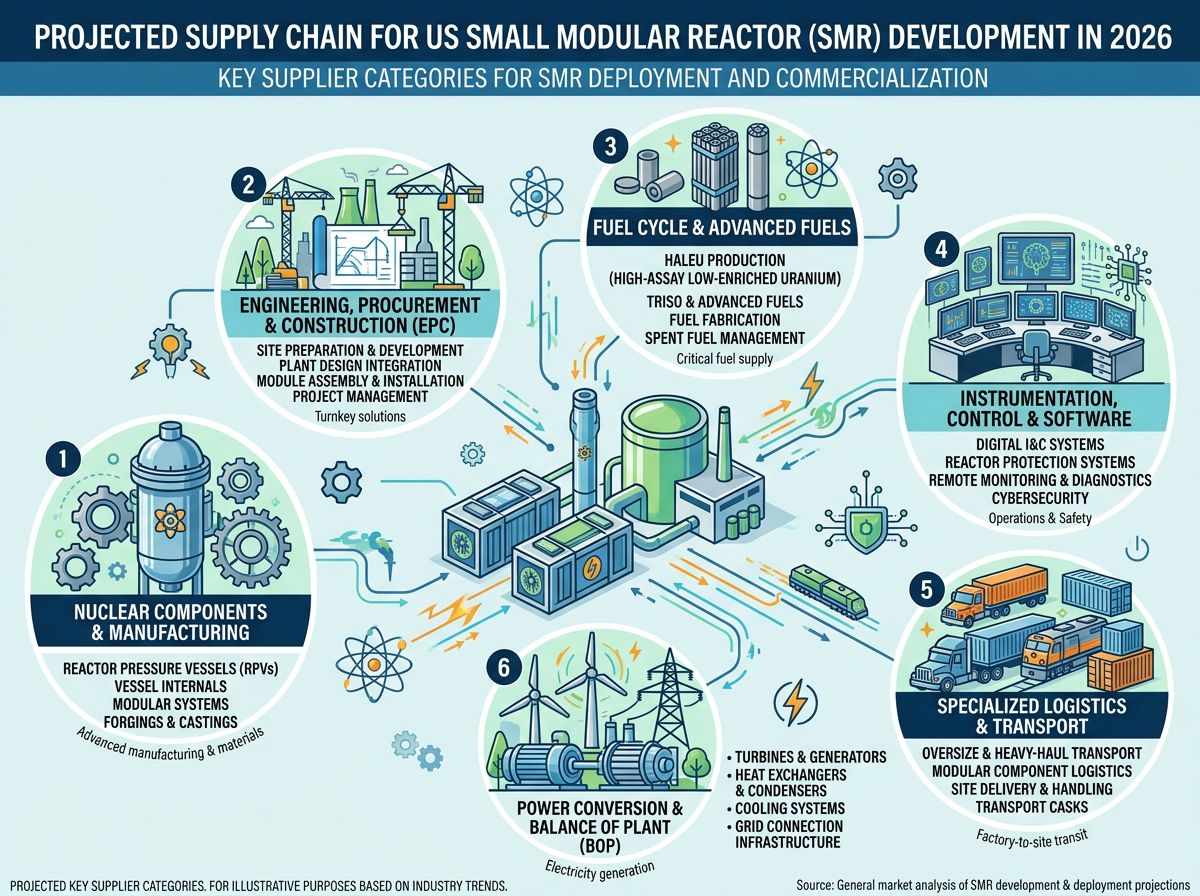
Every SMR project on our tracker needs thousands of qualified suppliers before it can build anything — components, materials, engineering services, fuel logistics, and much more. The industry is growing faster than its supply chain, which means real opportunity for businesses willing to navigate nuclear’s qualification process. Here’s how that process actually works.
Use the SMR Supplier Qualification Wizard linked below to prepare your business for entry into the growing Small Modular Reactor development industry. This tool will send you a PDF summary that helps confirm you have met the requirements necessary to join the SMR supply chain ecosystem within the United States.
Safety-Related vs. Non-Safety-Related: The First Fork in the Road
Not everything on an SMR project requires nuclear-specific qualification. The industry splits procurement into two tracks:
Safety-related items and services — components or work that affects the reactor’s safety systems. These require full nuclear quality assurance qualification under NQA-1 (Nuclear Quality Assurance-1) and 10 CFR 50 Appendix B.
Commercial-grade items — everything else. Standard industrial equipment, general construction services, IT infrastructure, and facility support don’t require nuclear-specific certification, though large projects will still expect standard commercial quality documentation.
If you’re evaluating whether your business fits, start here: does what you supply touch anything that could affect reactor safety, even indirectly? If not, you’re likely in the commercial-grade track, which is a far lower barrier to entry.
The Qualification Path for Safety-Related Suppliers
To supply safety-related items or services, a buyer (the utility, EPC firm, or reactor vendor) must verify your quality assurance program meets NQA-1 and Appendix B Criterion VII requirements. There are several accepted paths to that qualification:
- On-site QA program audit — the most rigorous method, typically required for the most safety-significant items. An auditor reviews your facility, QA manual, procedures, and records directly.
- Source inspection — inspectors verify your product during fabrication, which can substitute for or supplement a full QA audit for specific item types.
- Documented past performance — qualification based on a sufficient history of nonconformance-free deliveries of the same or similar items.
- Accepted certifications — holding an ASME N-stamp or CSA N299 registration can serve as evidence of an adequate QA program, provided it’s current.
Once qualified, you’re placed on that buyer’s Qualified Suppliers List (also called an Approved Vendors List). Qualification is scope-specific — being approved to supply one item type doesn’t automatically qualify you for a different one, and you’ll need periodic re-evaluation to stay on the list.
What Is the ASME N-Stamp, and Do You Need One?
The N-stamp is ASME’s certification mark for nuclear component manufacturers, and it remains one of the most globally recognized credentials in the industry — even countries with different regulatory systems still treat it as a meaningful signal of quality. If you manufacture pressure-boundary components, reactor internals, or similar safety-related hardware, pursuing N-stamp certification directly is often the most efficient path onto multiple buyers’ vendor lists at once, rather than qualifying separately with each one.
New reactor technologies — SMRs and high-temperature gas-cooled designs specifically — are actively working with ASME to update N-stamp criteria so it properly applies to their component types. If your business serves an emerging reactor technology, it’s worth tracking these code updates directly, since qualification requirements are still being finalized for some component categories.
Commercial-Grade Dedication: The Other Path In
If you make a high-quality industrial component that wasn’t originally designed for nuclear use, there’s a formal process called commercial-grade dedication that lets a buyer verify and “dedicate” your item for safety-related use without you needing full nuclear manufacturing certification. This is a meaningful opportunity for established industrial suppliers who’ve never worked in nuclear before — it’s a bridge, not a wall.
Where the Real Gaps Are Right Now
A few specific gaps are worth knowing if you’re deciding where to position your business:
Non-fuel critical materials. Nuclear-grade zirconium and hafnium, high-spec steels, nickel-based alloys, and rare-earth materials for reactor components are an emerging supply chain bottleneck, separate from the widely-discussed HALEU fuel shortage. Early first-of-a-kind projects are effectively setting the material specifications and supplier standards that later projects will follow for at least a full reactor generation — meaning the vendors who get qualified early have a durable advantage, since re-qualifying materials and N-stamp suppliers later is slow and expensive.
HALEU fuel logistics and supply chain services. Fuel enrichment gets most of the attention, but the logistics, handling, and supply chain coordination around fuel delivery is its own service category — NuScale’s recent supply chain expansion with Framatome specifically targeted fuel delivery acceleration.
Engineering and lifecycle services. Reactor vendors like X-energy are explicitly building out service offerings — project planning, assembly coordination, construction support, regulatory support, and procurement support — as standalone revenue lines, not just reactor sales. This is a services opportunity that doesn’t require manufacturing capability at all.
Practical First Steps
- Classify your offering — safety-related or commercial-grade. This determines your entire qualification path.
- Identify your target buyers — reactor vendors (TerraPower, X-energy, NuScale, Holtec) and EPC firms building their projects are the two buyer categories to approach.
- Check for existing overlap — if you already hold N-stamp, CSA N299, or ISO 19443 certification from other industrial work, you may already meet a buyer’s qualification bar.
- Get on a Qualified Suppliers List early — first-of-a-kind projects are setting standards that carry into future units. Early qualification is a durable position, not just a one-project contract.
- If you have procurement or vendor management experience from adjacent industries (telecom, utilities, industrial components), lead with it. Reactor vendors and EPC firms need experienced procurement partners as much as they need manufacturers — supply chain coordination is a named bottleneck across the industry right now.
U.S. SMR Company Vendor & Supplier Registration Links
| Company | US State(s) — SMR Development | Supplier Registration |
|---|---|---|
| TerraPower | Wyoming (Kemmerer — Natrium) | terrapower.com/suppliers |
| NuScale Power | Tennessee (TVA partnership, Clinch River site) | suppliers.nuscalepower.com |
| X-energy | Texas (Seadrift — Dow), Washington (Energy Northwest — Cascade) | x-energy.com/suppliers |
| GE Vernova Hitachi Nuclear (BWRX-300) | Tennessee (TVA Clinch River, Oak Ridge) | gevernova.com/nuclear/…/gvh-supplier-information |
Want to see which projects need suppliers soonest?