NRC Clears Framatome’s Richland Plant for TRISO Fuel as Lightbridge and QNI Pair Up on HALEU Supply
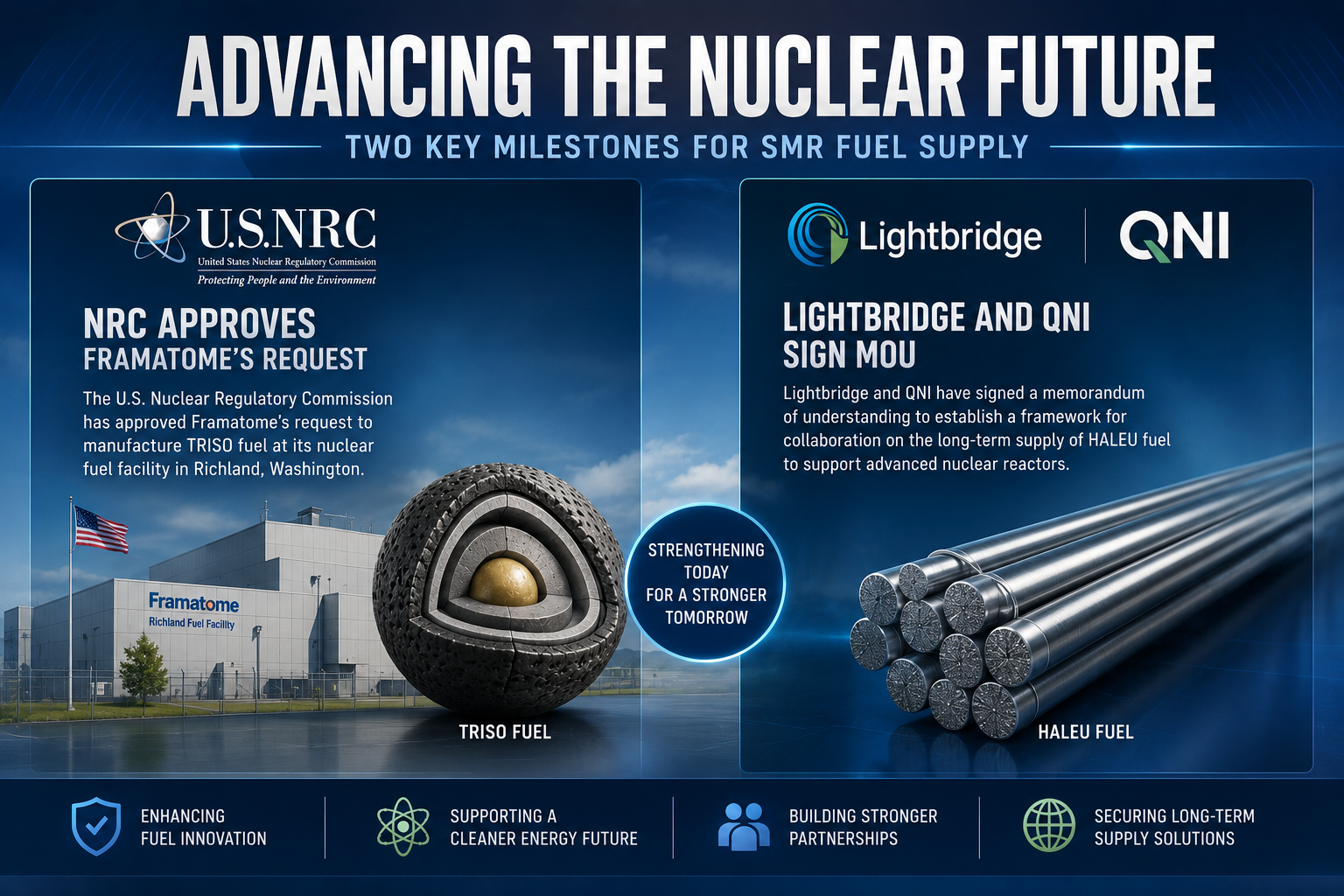
The U.S. advanced reactor fuel supply chain took two concrete steps forward in July 2026. First, the Nuclear Regulatory Commission approved a license amendment allowing Framatome’s Richland, Washington, fuel fabrication facility to manufacture Tri-Structural Isotropic (TRISO) fuel. Days later, Lightbridge Corporation and Quadrant Nuclear Industries (QNI) announced a memorandum of understanding to explore a long-term domestic supply arrangement for High-Assay Low-Enriched Uranium (HALEU). Neither event is a construction milestone or a reactor order — both are licensing and supply-chain groundwork. But for utilities, EPC firms, and municipalities tracking whether SMR and advanced reactor projects will actually have fuel to run on, licensing and supply-chain groundwork is exactly what determines whether 2030-era deployment timelines are realistic.
Here is what was actually confirmed, what it means, and what’s still unresolved.
NRC Approves Framatome’s Richland Facility for TRISO Fuel Manufacturing
On July 23, 2026, Framatome announced that the NRC had approved a license amendment request (LAR) for its Richland, Washington fuel fabrication facility, authorizing uranium enrichment levels up to 10% at the site. According to Framatome’s press release, the approval specifically authorizes the facility’s dry conversion process — which converts uranium hexafluoride (UF6) into uranium oxide (UO2 and U3O8) powder — for reactor fuel types that require enrichment above the roughly 5% used in the existing U.S. light-water reactor (LWR) fleet, including the fabrication of TRISO fuel. [Source: Framatome press release, July 23, 2026]
Two regulatory details matter here for anyone tracking the pace of advanced reactor deployment:
The LAR itself was filed with the NRC under 10 CFR Part 70 (the federal rule governing licenses to possess and use special nuclear material) in September 2024, according to both Framatome and a joint announcement from Standard Nuclear. That is roughly a 22-month review-to-approval timeline for a single amendment — a useful real-world data point for anyone modeling how long NRC licensing takes for facilities seeking to handle higher-enriched fuel.
Framatome describes this as its second enrichment-related NRC approval in short order, following what the company called a “sitewide” approval the prior month authorizing fuel enrichment above 5% for the LWR market. Framatome has not published exact scope details distinguishing the two approvals beyond what appears in its own release, so we’re citing the company’s characterization directly rather than independently verifying the earlier approval’s exact date or scope.
Framatome also disclosed that the 10% enrichment approval “positions” the Richland site for future HALEU fuel production (enrichment up to 20%), and that the company has applied for U.S. Department of Energy HALEU availability funding. That is a forward-looking company statement, not a completed regulatory action — worth flagging as such rather than treating it as done.
Why This Approval Is Tied to a Specific Joint Venture
The TRISO approval is not a standalone capability play. In September 2025, Framatome and Standard Nuclear — which describes itself as the only independent U.S. developer of TRISO fuel — announced a joint venture, branded Standard Nuclear-Framatome (SNF), to build TRISO fabrication capacity at the Richland site. [Source: Business Wire, September 29, 2025] At announcement, the companies targeted an initial production rate of 2 metric tons of TRISO fuel annually, reactor-agnostic and aimed at supplying small modular reactor (SMR) and microreactor developers.
Framatome’s July 2026 release states the LAR approval is “a major milestone” for that joint venture and reiterates a 2027 target for the Richland site to begin manufacturing UO2 powder and TRISO particles — consistent with the 2027 commissioning target both companies cited in 2025.
For broader context, Standard Nuclear separately reported in July 2026 that two other TRISO facilities it is building independently of Framatome — one in Tennessee (SN-TN) and one in Idaho (SN-ID) — have DOE approval of their preliminary documented safety analyses and are under a separate DOE authorization pathway (the Fuel Line Pilot Program) rather than a full NRC license. [Source: American Nuclear Society/Nuclear Newswire, July 24, 2026] That distinction matters for anyone comparing timelines: DOE-pathway facilities and NRC-licensed commercial facilities like Richland move through different regulatory processes, and readers should not assume the same schedule applies to both.
The Richland facility itself is not new to nuclear fuel manufacturing. Framatome states the site has operated for more than 55 years, currently employs more than 600 people, and recently completed an NRC Licensee Performance Review extending a 20-year record with no findings requiring improvement — a relevant operational-history data point for utilities and EPC firms evaluating supplier reliability, separate from the enrichment approval itself.
Lightbridge and QNI Sign MOU on Long-Term HALEU Supply
On July 27, 2026, Lightbridge Corporation (Nasdaq: LTBR) and Quadrant Nuclear Industries Inc. (QNI) announced a non-binding memorandum of understanding to establish a framework for collaborating on long-term HALEU fuel supply. [Source: GlobeNewswire / Lightbridge Corporation, July 27, 2026]
The specifics disclosed in the joint release:
The companies will discuss potential supply and long-term offtake of HALEU produced at QNI’s planned Vanguard facility at Idaho National Laboratory. QNI states Vanguard is designed to produce up to 18 metric tons of HALEU annually at full capacity, intended to serve both commercial and government markets.
The MOU explicitly does not establish pricing, quantity, or exclusivity commitments. Any binding supply agreement would require a separate, definitive contract following further negotiation — a distinction the release states directly rather than something we’re inferring.
Lightbridge Chairman and CEO Seth Grae framed the agreement as groundwork for the company’s fuel commercialization plans: “As we progress in the development and regulatory licensing of Lightbridge Fuel™, it is critical that we begin solidifying a reliable domestic supply of HALEU.” QNI CEO Dee Mewbourne described the goal as “a framework for a long-term offtake arrangement that supports commercialization of Lightbridge’s advanced fuel technology while strengthening the domestic nuclear fuel ecosystem.”
QNI is a newer entrant in the domestic fuel-cycle space, and its Vanguard facility is still in the planning stage — it has not broken ground as of this MOU. QNI’s credibility on HALEU supply is not solely self-asserted: in June 2026, molten salt reactor developer Natura Resources announced a separate, formal HALEU offtake agreement with QNI, an independent data point suggesting QNI has more than one active discussion in this space. [Source: American Nuclear Society/Nuclear Newswire, June 15, 2026] Readers should still treat QNI’s production capacity figures as company-disclosed planning targets, not independently audited output, since the facility has not been built or licensed for operation.
Lightbridge, for its part, is developing Lightbridge Fuel™, a metallic fuel technology intended for both existing light-water and pressurized heavy-water reactors as well as future SMRs. The company holds two long-term framework agreements with Battelle Energy Alliance (the DOE’s operating contractor for Idaho National Laboratory) and has twice received support through DOE’s Gateway for Accelerated Innovation in Nuclear (GAIN) program, according to its own investor materials — background worth noting as company-sourced rather than third-party verified.
What This Means for the SMR Fuel Supply Chain
Put together, these two announcements point to the same underlying constraint: advanced reactors and SMRs need fuel forms — TRISO and HALEU — that the existing commercial fuel-cycle infrastructure was never built to produce at scale, and both regulatory licensing and physical production capacity are still being stood up in parallel, not sequentially.
The Framatome/Standard Nuclear news shows an NRC-licensed, decades-old commercial facility clearing a specific regulatory hurdle to manufacture TRISO fuel at meaningful volume, with a 2027 production target. The Lightbridge/QNI news shows an earlier-stage, non-binding conversation between a fuel technology developer and a HALEU producer whose flagship facility hasn’t been built yet. These are different points on the same maturity curve. Utilities, EPC firms, and municipalities evaluating specific SMR or advanced reactor projects should track the underlying regulatory filings and construction status directly — an MOU is a stated intent to negotiate, not a supply contract, and a license amendment approval is not the same as fuel actually shipping.
Neither announcement changes near-term SMR project economics or siting decisions on its own. Both are the kind of infrastructure-layer development worth watching if you’re assessing supplier qualification or fuel supply risk for a specific advanced reactor project.
Sources
- Framatome makes major progress in advanced reactor fuel manufacturing with latest U.S. Nuclear Regulatory approval — Framatome press release, July 23, 2026
- Feds sign off on expanded license for Framatome’s Richland plant — Tri-Cities Area Journal of Business, May 6, 2026
- Standard Nuclear, Framatome Announce a U.S.-based TRISO Nuclear Fuel Production Joint Venture — Business Wire, September 29, 2025
- Standard Nuclear plans TRISO production at two new facilities in 2026 — American Nuclear Society / Nuclear Newswire, July 24, 2026
- Lightbridge Corporation and Quadrant Nuclear Industries Announce Memorandum of Understanding to Advance Domestic HALEU Fuel Supply — GlobeNewswire, July 27, 2026
- Natura agrees to HALEU offtake from nuclear start-up QNI — American Nuclear Society / Nuclear Newswire, June 15, 2026
- Framatome, Inc.; Framatome Fuel Fabrication Facility; License Amendment Application — Federal Register, October 2, 2025