SMR Fuel Types Compared: TRISO, HALEU Metal, and Molten Salt Fuel
A Comparison of Top SMR Fuel Types
Every small modular reactor design under development in the United States is, at its core, a bet on a specific fuel form. The pressure vessel, coolant loop, and safety case all follow from that choice. For utilities, EPC firms, and municipalities evaluating which SMR technology to site, the fuel type determines three things that drive project economics directly: how often the plant needs to be refueled, how much and what kind of waste it produces, and how exposed the project is to a fuel supply chain that is still being built.
This article compares the four fuel types currently competing for commercial SMR deployment: conventional low-enriched uranium (LEU) fuel used in light-water SMRs, TRISO coated-particle fuel used in gas- and salt-cooled reactors, HALEU metal fuel used in fast-spectrum reactors, and liquid dissolved fuel used in molten salt reactors. Every figure below is attributed to its source. Where independent, verified data was not available, that gap is stated rather than filled with a vendor estimate.
Why Fuel Type Is the Real Design Decision
Reactor developers frequently market their designs by coolant (sodium-cooled, gas-cooled, salt-cooled) or by size class. But the coolant is downstream of the fuel decision. The fuel’s chemical and physical form sets the maximum burnup the core can reach, dictates what the spent fuel looks like when it comes out, and determines what enrichment level the plant needs — which in turn determines which part of the still-developing U.S. HALEU supply chain the project depends on.
The Department of Energy’s HALEU Availability Program has already flagged that gap as the central risk facing the advanced nuclear industry: demand from reactor developers is running ahead of domestic enrichment capacity (World Nuclear News). Any organization evaluating an SMR site or supplier relationship needs to understand which fuel category a given vendor is committed to, because that choice is not easily reversed once a design is licensed.
The Four Fuel Types
1. Conventional LEU Uranium Dioxide (Light-Water SMRs)
Reactors: GE Hitachi BWRX-300, NuScale VOYGR
This is the least novel fuel on the list, and that is largely the point. Light-water SMRs use uranium dioxide (UO2) pellets enriched to less than 5% U-235 — the same low-enriched uranium (LEU) fuel form used in the existing U.S. commercial reactor fleet (NRC; World Nuclear Association). The BWRX-300 supports 12- to 24-month fuel cycles, consistent with standard BWR practice (NRC).
- Power output: BWRX-300 is rated at approximately 300 MWe per unit (NRC).
- Longevity: Standard PWR/BWR discharge burnup runs roughly 45-62 GWd/MTU under current fuel-vendor limits, with 12- to 24-month refueling intervals — well-established figures from decades of commercial LWR operation (OECD NEA).
- Waste: A DOE-supported multidisciplinary study found that NuScale’s VOYGR spent fuel is broadly similar in character to existing LWR spent fuel — the most well-characterized waste stream of any option on this list, since it draws on 60+ years of LWR operating history (ScienceDirect).
- Cost: A bottom-up techno-economic analysis modeling a 12×77 MWe light-water SMR plant found an overnight capital cost of $4,844/kW and a levelized cost of energy (LCOE) of $89.6/MWh — the highest of the three configurations that study modeled (OSTI).
The tradeoff: light-water SMR fuel is the most mature and lowest-risk option from a licensing and supply-chain standpoint, but it gives up the higher burnup and longer core life that newer fuel forms are designed to unlock.
2. TRISO Coated-Particle Fuel (HALEU, Gas- and Salt-Cooled)
Reactors: X-energy Xe-100 (helium-cooled, pebble bed); Kairos Power Hermes (fluoride-salt-cooled, pebble bed)
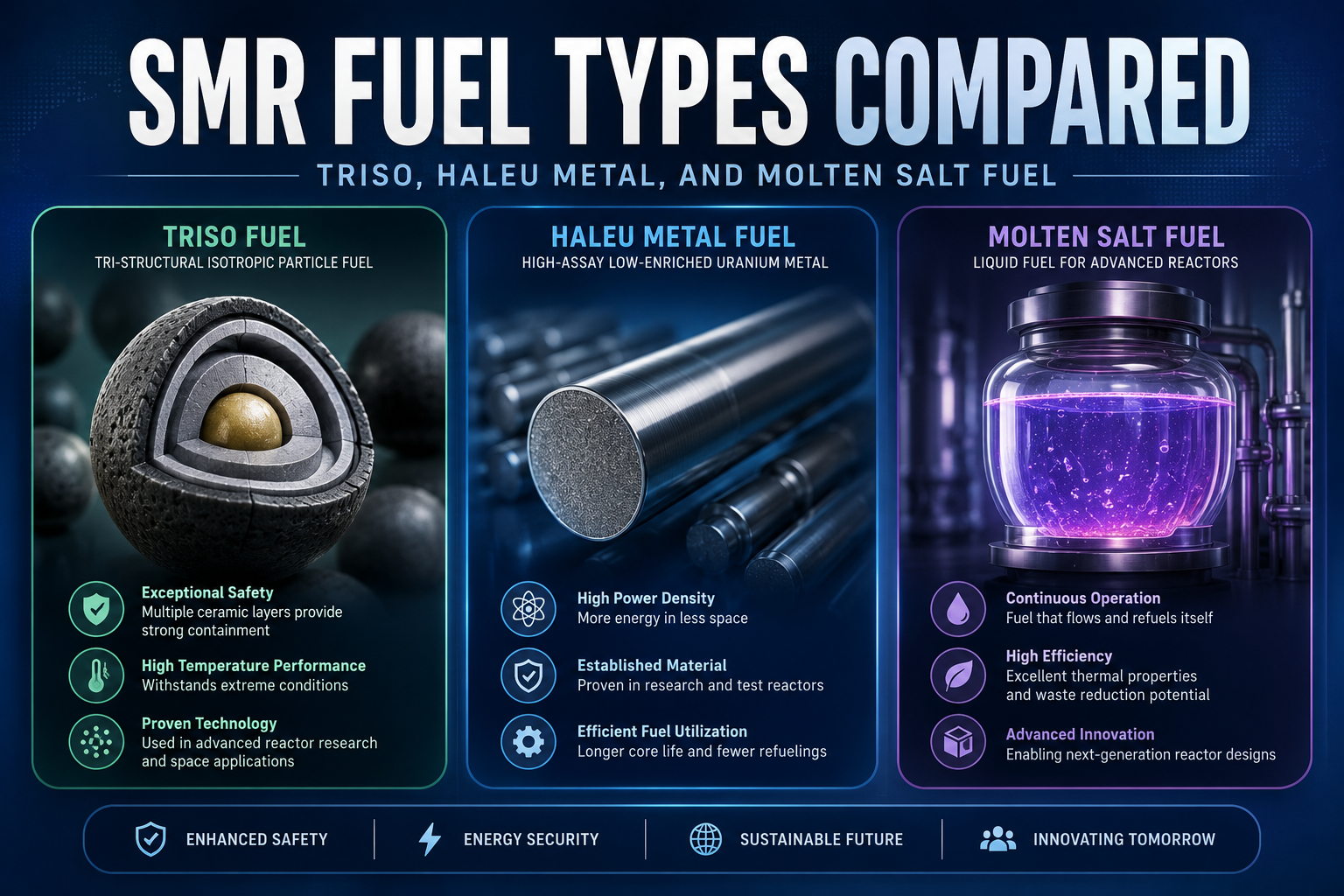
TRISO — tri-structural isotropic — fuel encapsulates a uranium kernel (UO2, UC, or uranium oxycarbide) inside four layers: a porous carbon buffer, an inner pyrolytic carbon layer, a silicon carbide layer that acts as the primary pressure vessel, and an outer pyrolytic carbon layer. Each particle, about the size of a poppy seed, is engineered to retain fission products at temperatures well beyond what the reactor is expected to reach, which is the basis for TRISO developers’ claims that the fuel “cannot melt down” (PNNL/NRC; Kairos Power). TRISO fuel requires HALEU, enriched to between 5% and 20% U-235 (NRC).
Thousands of these particles are pressed into fuel pebbles (X-energy, Kairos) or fuel compacts inside prismatic graphite blocks (a competing TRISO geometry not yet fielded in a licensed U.S. commercial SMR). Pebble-bed designs allow continuous online refueling — pebbles circulate through the core and are recycled until they reach their burnup limit — while prismatic cores require periodic shutdown and fuel shuffling (Wiley).
- Power output: The Xe-100 produces 200 MWt / 80 MWe per unit at 40% thermal efficiency; a standard four-unit plant totals 320 MWe (X-energy; World Nuclear News coverage of Xe-100 design milestones).
- Longevity: Pebble-bed cores can drive fuel to its full allowed burnup limit — typically cited at 150-160 MWd/kg heavy metal — because continuous pebble recirculation avoids the excess reactivity that fixed-fuel cores must carry. Prismatic TRISO cores proposed today are generally designed for a lower 15-50 MWd/kg range (ScienceDirect pebble-bed burnup analysis; Lorenzo Venneri technical overview).
- Waste: The same DOE-supported waste study found Xe-100’s spent fuel is lower density but larger in volume than light-water SMR spent fuel — more pebbles per unit of energy produced, even though each pebble contains less fissile material. The tradeoff runs the other way in the repository: TRISO-based spent fuel showed a smaller repository footprint and lower peak dose rate than other designs studied (ScienceDirect). A separate Stanford-affiliated analysis reached a more cautious conclusion, finding that several SMR designs — including TRISO-fueled concepts — could produce more spent fuel volume per unit of energy generated than conventional LWRs depending on the metric used (Stanford Report). Both findings are from credentialed sources and are presented here because they do not fully agree — the honest read is that TRISO waste volume and waste hazard are not the same measurement, and vendors citing one without the other are giving an incomplete picture.
- Cost: The same techno-economic study modeling a 4×262 MWe gas-cooled SMR plant found an overnight capital cost of $4,355/kW and an LCOE of $81.5/MWh (OSTI).
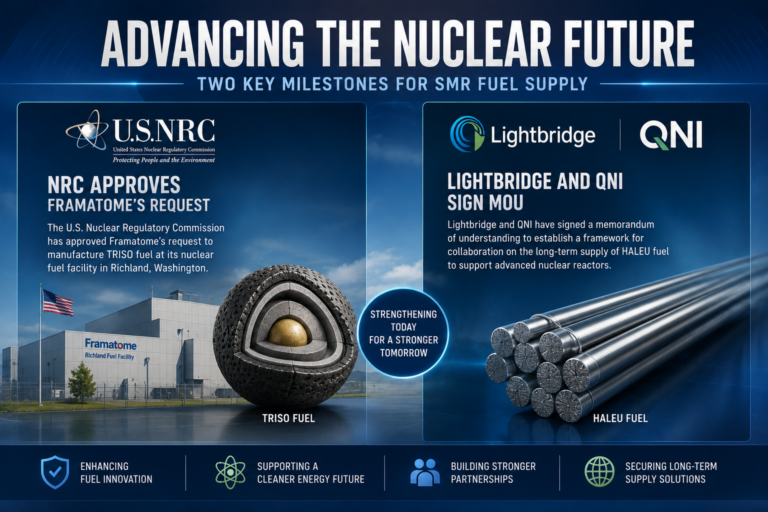
TRISO fuel fabrication is itself a new industry: X-energy subsidiary TRISO-X received the first new NRC commercial fuel fabrication license in 50 years in February 2026, with production targeted for 2028 (Energy Intelligence; Interesting Engineering).
3. HALEU Metal Fuel (Fast-Spectrum Reactors)
Reactors: TerraPower Natrium (sodium-cooled), Oklo Aurora (heat-pipe-cooled)
Metal fuel — a uranium-zirconium alloy rather than an oxide ceramic — is the fuel form used in fast-spectrum SMRs. Because these reactors run on fast (not thermalized) neutrons, they do not use water as a moderator; Natrium uses liquid sodium as coolant, while Oklo’s Aurora uses heat pipes to move heat out of the core to a supercritical CO2 power conversion system. Both use HALEU: Natrium requires roughly 15-20 metric tons of HALEU metal fuel for its first core load and approximately 3.6 metric tons per year afterward for refueling (TerraPower). TerraPower has stated Natrium follows a once-through fuel cycle with no reprocessing, intended to keep spent fuel intact, countable, and infrequently handled (TerraPower).
- Power output: Natrium is rated at 345 MWe (Neutron Bytes reporting on TerraPower’s Meta agreement). Oklo’s Aurora Powerhouse design has been scaled to a 50 MW platform offering flexible output between 15 MW and 75 MW (reporting on Oklo’s Q4 2024 earnings call design update).
- Longevity: This is where fast-spectrum metal fuel claims its biggest advantage. Oklo has stated the Aurora can run for extended periods without refueling, with public figures ranging from roughly 10 years up to 20 years depending on configuration and source (Interesting Engineering). These are company-sourced or company-derived figures rather than figures from an independent third-party burnup study, and should be read as vendor projections, not confirmed operating data, until Aurora accumulates actual operating history at Idaho National Laboratory.
- Waste: The DOE-supported waste study found Natrium produces a more concentrated spent fuel stream with different long-lived isotope characteristics than light-water or gas-cooled designs — smaller volume, different hazard profile (ScienceDirect). Oklo has stated Aurora can also run on recycled used nuclear fuel rather than only fresh HALEU, which — if demonstrated at commercial scale — would be a distinct waste-reduction pathway from anything else on this list (World Nuclear News reporting on Oklo). That capability has not yet been demonstrated in a licensed, operating commercial reactor, so it is noted here as a design goal, not a confirmed result.
- Cost: No independent, third-party techno-economic analysis of metal-fueled fast-reactor SMR costs comparable to the light-water/gas-cooled/molten-salt study cited elsewhere in this article turned up in this research. Any $/kW or LCOE figure for Natrium or Aurora currently circulating is a company estimate. This is flagged as a confirmed data gap rather than filled with a vendor number.
4. Liquid Fuel Salt (Molten Salt Reactors)
Reactors: Terrestrial Energy IMSR
The fourth category is the most chemically distinct: instead of solid fuel pellets or pebbles, uranium tetrafluoride (UF4) is dissolved directly into the molten fluoride salt that also serves as the primary coolant. There is no fuel cladding and no separate coolant loop touching solid fuel — the fuel salt itself flows through the primary system (Wikipedia summary of NRC/IAEA filings; World Nuclear Association). Because fission products dissolve into the salt rather than being trapped in solid fuel, some liquid-fuel MSR designs are engineered for continuous online removal of fission products, which the World Nuclear Association notes can support burnup levels above 50% — dramatically higher than solid-fuel designs — while also reducing post-shutdown decay heat (World Nuclear Association).
This comes with a distinct waste-handling challenge: liquid-fuel MSRs generate meaningfully more tritium gas than pressurized water reactors, and operators must condition and immobilize the spent fuel salt and its off-gas into solid, durable waste forms rather than simply storing intact fuel assemblies — a waste stream type the current U.S. regulatory and repository framework has less operating history with than solid spent fuel (World Nuclear Association).
- Power output: Terrestrial Energy’s upgraded IMSR400 design pairs two 195-MWe reactor units for 390 MWe total (POWER Magazine).
- Longevity: Terrestrial Energy states the design is intended to run at 600°C, roughly 50% more thermally efficient than conventional light-water reactors, and to produce roughly 40% less nuclear waste as a result of that efficiency gain — company figures, cited here as the vendor’s own claim rather than an independently verified benchmark (POWER Magazine).
- Waste: See above — potentially lower solid waste mass per unit of energy due to higher burnup and thermal efficiency, offset by the tritium and off-gas conditioning burden that solid-fuel designs do not have (World Nuclear Association).
- Cost: The same techno-economic study modeling a 5×200 MWe molten salt SMR plant found the lowest overnight capital cost of the three configurations modeled — $3,985/kW — and the lowest LCOE, at $80.6/MWh (OSTI). It is worth noting this study modeled a generic molten salt SMR configuration for cost purposes, not the IMSR design specifically, so the figure should be read as directionally representative of the fuel category rather than a quote for any single vendor’s plant.
One important distinction worth flagging for anyone researching this space: Kairos Power’s Hermes reactor is often grouped with molten salt reactors because it uses a fluoride salt coolant, but its fuel is solid TRISO pebbles, not dissolved fuel salt. Hermes belongs in the TRISO category above, not this one — a distinction that matters because the two fuel forms have entirely different waste and reprocessing profiles.
Side-by-Side Comparison
| Fuel Type | Example Reactors | Power Output (per unit) | Burnup / Refueling | Overnight Capital Cost | LCOE |
|---|---|---|---|---|---|
| LEU UO2 (light water) | BWRX-300, NuScale VOYGR | ~300 MWe | ~45-62 GWd/MTU; 12-24 mo. cycles | $4,844/kW | $89.6/MWh |
| HALEU TRISO (gas/salt-cooled) | X-energy Xe-100, Kairos Hermes | 80 MWe (200 MWt) | Up to ~150-160 MWd/kg (pebble); 15-50 MWd/kg (prismatic) | $4,355/kW | $81.5/MWh |
| HALEU metal fuel (fast-spectrum) | TerraPower Natrium, Oklo Aurora | 345 MWe (Natrium); 15-75 MWe (Aurora) | ~1 yr (Natrium refuel cadence); 10-20 yrs claimed (Aurora, unverified) | Not independently studied — data gap | Not independently studied — data gap |
| Liquid fuel salt (molten salt) | Terrestrial Energy IMSR | 195 MWe per unit (390 MWe paired) | >50% burnup potential (category-level, per WNA) | $3,985/kW | $80.6/MWh |
Cost figures for the LEU, TRISO, and molten-salt rows come from one peer-reviewed bottom-up techno-economic study and are directly comparable to each other; they should not be read as forecasts for any specific vendor’s actual project cost, which will vary by site, labor market, and first-of-a-kind premium. See the Sources section for the full citation.
What This Means for Evaluating an SMR Vendor or Site
None of these four fuel types is categorically “best” — each trades against the others on a different axis. Light-water LEU fuel carries the lowest technology risk and the most predictable licensing path, at the cost of the lowest burnup and highest modeled LCOE of the group. TRISO fuel offers the highest theoretical burnup and a strong passive-safety case, but its fabrication supply chain (TRISO-X, Standard Nuclear) only received its first commercial NRC license in 2026 and has not yet operated at scale. HALEU metal fuel in fast reactors offers the longest refueling intervals — if Oklo’s projections hold up in actual operation — but has no independent third-party cost study to check vendor claims against. Liquid fuel salt reactors offer the best burnup economics on paper but introduce a tritium and waste-conditioning problem that the other three fuel types don’t have.
For a utility, EPC firm, or municipality sizing up a vendor relationship or evaluating a site, the fuel type a developer has committed to is a proxy for the project’s supply-chain risk, refueling logistics, and regulatory precedent — not just its physics. A developer’s fuel choice should be checked against the current state of the HALEU supply chain before assuming any published core-life or refueling-interval figure will hold on the timeline being pitched.
This article is independent research for planning purposes and does not constitute financial, engineering, or investment advice. Cost and performance figures for reactors that have not yet completed construction or full-scale operation — including Natrium, Aurora, Xe-100, Hermes, and IMSR — are design-stage projections and are subject to change as licensing and construction proceed.
Sources
- NRC — BWRX-300 Pre-Application Activities
- NRC — High-Assay Low-Enriched Uranium (HALEU)
- NRC / PNNL — TRISO Fuel: Properties and Failure Modes
- World Nuclear Association — High-Assay Low-Enriched Uranium (HALEU)
- World Nuclear Association — Molten Salt Reactors
- World Nuclear News — DOE delivers HALEU feedstock for advanced reactor fuel
- World Nuclear News — Oklo breaks ground for first Aurora powerhouse
- Energy Intelligence — Approval of TRISO-X Facility
- OECD NEA — Very High Burn-ups in Light Water Reactors
- ScienceDirect — Nuclear waste attributes of near-term deployable SMRs
- ScienceDirect — Optimized fuel cycle and burnup analysis for pebble-bed reactors
- Stanford Report — Small modular reactors produce high levels of nuclear waste
- OSTI — Techno-economic analysis of advanced small modular nuclear reactors
- X-energy — Xe-100
- TerraPower — Natrium Program Summary
- Neutron Bytes — TerraPower in Mega Deal with Meta for Eight Natrium 345 MW Plants
- POWER Magazine — Terrestrial Energy Launches 390-MW Molten Salt Reactor Design
- Kairos Power — Hermes Construction Update
- Interesting Engineering — Aurora nuclear reactor may run US base for 10 years without refueling