Why the BWRX-300 Is Emerging as the Flagship Reactor of the US-Japan-Korea SMR Framework
A precision note before anything else: the July 7, 2026 US-Japan-Korea memorandum of cooperation (MOC) on small modular reactors does not name, endorse, or select a reactor design. It’s a government-to-government framework for coordinating third-country SMR deployment in the Indo-Pacific. We cover that document in detail on our trilateral agreement explainer.
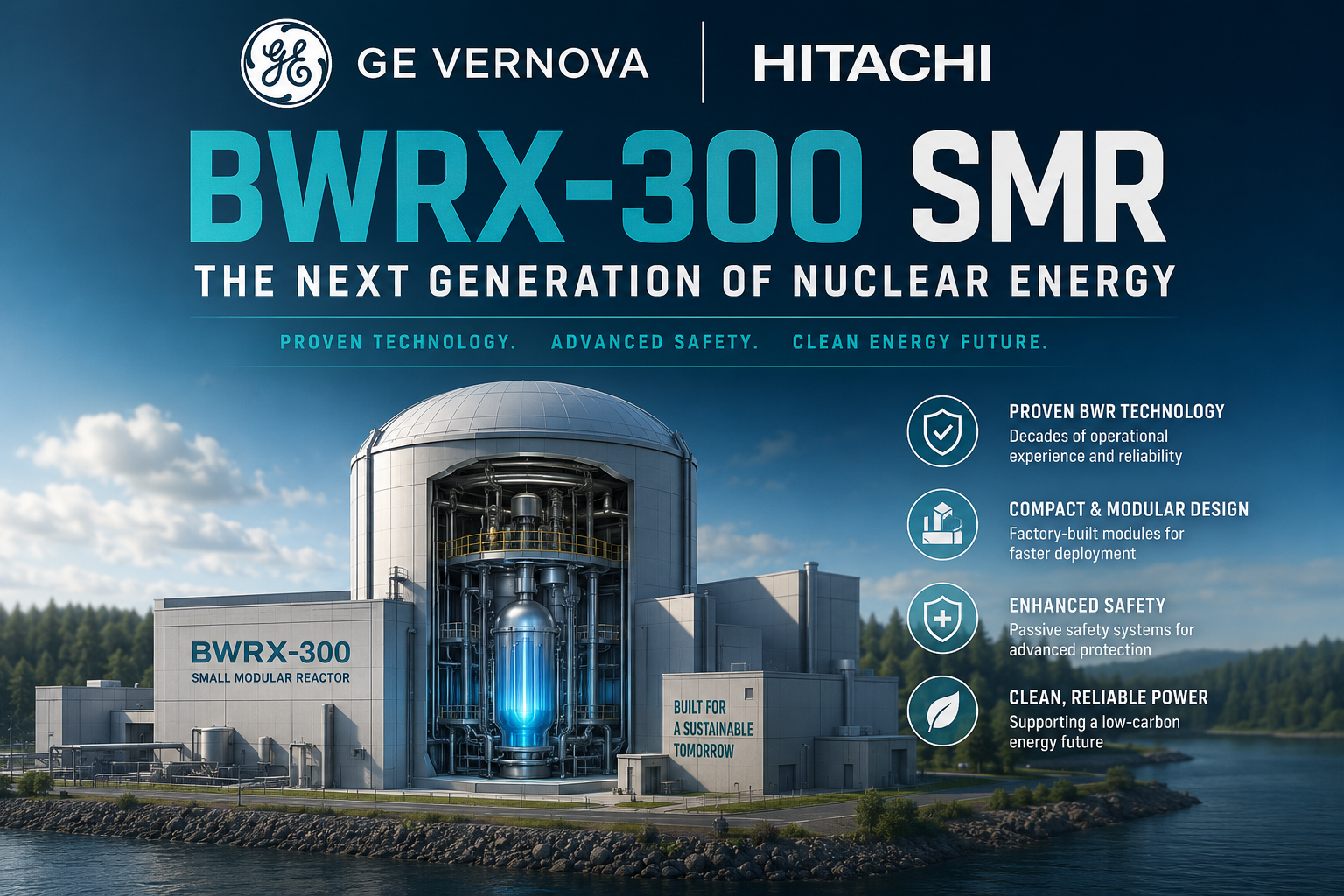
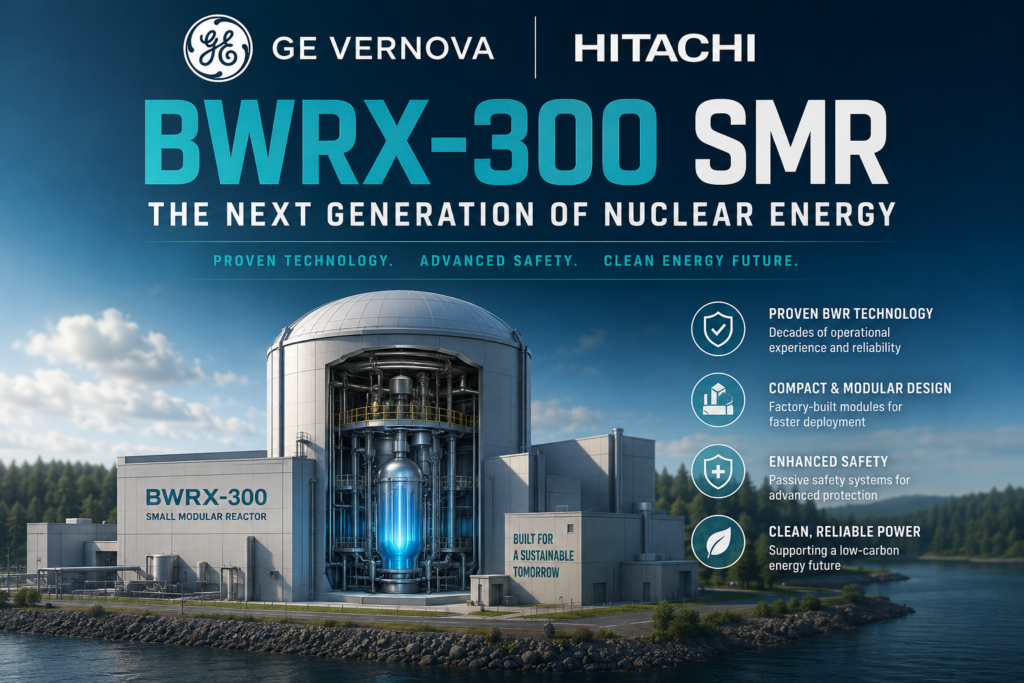
What this article covers is different: a company-level industry initiative, announced by the US State Department in the same news cycle as the MOC, in which GE Vernova (USA), Hitachi (Japan), and Samsung C&T (South Korea) — joined by Poland’s SGE — agreed to coordinate deployment of the BWRX-300 small modular reactor across Europe. That roster is the reason BWRX-300 is emerging as the de facto flagship design of the broader US-Japan-Korea nuclear relationship, even though no government document formally designates it as such. This page lays out that case, and backs it with a cost and capability comparison against two of its closest SMR competitors: NuScale’s VOYGR and X-energy’s Xe-100.
What actually happened on July 7, 2026
On the margins of the NATO Summit in Ankara, Türkiye, US Secretary of State Marco Rubio, Japan’s Foreign Minister Motegi Toshimitsu, and South Korea’s Foreign Minister Cho Hyun signed a memorandum of cooperation covering three things: joint identification of Indo-Pacific countries interested in SMRs, encouragement of industry consortiums over country-vs-country bidding, and more than $10 million in new US funding for the State Department’s FIRST technical-assistance program. Full sourcing and detail on that document is on our companion page. Source: World Nuclear News.
Bundled into that same announcement — as a separate, company-level item — was the BWRX-300 industry initiative. The State Department’s own language ties the two together only loosely: the initiative “will help achieve the ambitions set forth in the memorandum signed today and deepen government-industry partnerships to strengthen global energy security.” It’s a signal of alignment, not a procurement decision.
The case for BWRX-300 as the trilateral relationship’s flagship design
Three independent facts point to BWRX-300, not because any government chose it, but because of where the commercial and regulatory momentum already sits.
1. Its industry consortium mirrors the trilateral partnership exactly. GE Vernova is American. Hitachi is Japanese. Samsung C&T is Korean. That’s not a coincidence worth glossing over — it’s the same three-country lineup as the signatories of the MOC, meeting on the same day, in the same announcement. No competing SMR design has a comparable ownership structure spanning all three trilateral nations.
2. It’s the furthest along in construction of any Western SMR design. GE Vernova Hitachi Nuclear Energy’s (GVH’s) first BWRX-300 is under construction at Ontario Power Generation’s Darlington site in Canada — the reference unit for the design, which received its construction licence from the Canadian Nuclear Safety Commission in April 2025, with completion targeted by the end of the decade. Source: World Nuclear News; CNSC project page. No VOYGR or Xe-100 unit has reached this stage anywhere in the world.
3. It’s furthest along in US licensing among advanced reactor construction permits. In June 2026, NRC staff published a safety evaluation report formally recommending that the Commission issue a construction permit to the Tennessee Valley Authority for a BWRX-300 at the Clinch River site in Oak Ridge, Tennessee — the first advanced reactor construction permit application of its kind to reach this stage of NRC review, with a mandatory hearing scheduled for August 13, 2026. Source: energiesmedia, citing NRC; NRC BWRX-300 docket.
Underpinning all of this is a regulatory shortcut most competing designs don’t have: the BWRX-300 leverages the design and licensing basis of GVH’s already NRC-certified ESBWR boiling water reactor and its existing, licensed GNF2 fuel design, rather than starting from a blank sheet. That lineage is a material reason it has moved faster through licensing than ground-up designs. Source: World Nuclear News.
None of this means BWRX-300 has “won.” It means that among the reactor designs with a plausible claim to the trilateral relationship, it’s the one with a national ownership structure matching the agreement and hard construction/licensing progress to point to — not just an announcement.
Cost and capability comparison: BWRX-300 vs. NuScale VOYGR vs. X-energy Xe-100
Two important caveats before the table. First, no unit of any of these three designs has reached commercial operation anywhere in the world as of this writing, so every cost figure below is a pre-completion estimate, not a delivered project cost — treat these as planning-level reference points, not quotes. Second, capacity factor and availability figures below are vendor specifications, not results from completed plants; we’ve labeled them as such rather than presenting them as independently verified.
| Data Type | BWRX-300 (GE Vernova Hitachi) | VOYGR-6 (NuScale Power) | Xe-100 four-pack (X-energy) |
|---|---|---|---|
| Reactor type | Water-cooled, natural-circulation boiling water reactor (BWR) | Integral pressurized water reactor (iPWR), 6 modules | Pebble-bed high-temperature gas-cooled reactor (HTGR), 4 units |
| Net output | 300 MWe / 870 MWth per unit | 462 MWe gross (6 × 77 MWe modules) | ~320 MWe / 800 MWth combined |
| Coolant / fuel | Light water / licensed GNF2 fuel | Light water / low-enriched uranium (≤4.95% U-235) | Helium / TRISO pellets in HALEU pebbles |
| Vendor capacity factor / availability claim | ~95% capacity factor (design target) | ≥95% capacity factor (design target) | 93–95% availability (design target; not the same metric as capacity factor) |
| US NRC status (as of July 2026) | Pre-certification; construction permit for TVA’s Clinch River unit recommended by NRC staff June 2026, hearing Aug. 13, 2026 | Original 50 MWe design NRC-certified 2023 (first US SMR to achieve this); uprated 77 MWe module design approved May 29, 2025 | Pre-application; Dow/Long Mott construction permit application docketed, NRC targeting an 18-month review, possible decision by end of 2026 |
| Furthest-along reference project | Darlington, Ontario, Canada — construction underway, targeting completion by decade’s end | Carbon Free Power Project (Idaho, UAMPS) — terminated Nov. 8, 2023 before construction began | Long Mott Generating Station, Texas (Dow Long Mott Energy LLC) — construction permit under NRC review, not yet approved |
| Most recent public cost data | CAD 7.7 billion (~US$5.6 billion) for the first unit plus shared site infrastructure; CAD 20.9 billion (~US$15.1 billion) total for the planned four-unit Darlington project | Project cost rose to $9.3 billion for 462 MWe (~$20,000/kW) before cancellation, up from an original $3.6 billion estimate for 720 MWe in 2020 | No public construction cost has been disclosed for the Long Mott project as of this writing |
| Best-suited application | Grid-scale baseload / dispatchable power | Grid-scale baseload, load-following; modular scaling | Industrial process heat (steam to 565°C) and grid power — best fit for co-located industrial users like chemical plants |
Sources for the table: World Nuclear News, GE Vernova BWRX-300 general description, NRC — GVH BWRX-300, NRC — VOYGR design certification, NuScale technical specifications, NRC — Xe-100, X-energy Xe-100 technology explainer, X-energy Dow construction permit filing coverage — POWER Magazine, World Nuclear Report — Darlington cost.
The NuScale CFPP figure deserves one clarification: NuScale’s design itself was not the reason the Idaho project ended. UAMPS and NuScale mutually terminated the Carbon Free Power Project in November 2023 after the utility consortium determined it could not secure enough subscribers at the escalated price, not because of a licensing or technical failure — the underlying VOYGR design retains its NRC certification. It’s a project-economics data point, not a verdict on the technology.
Reading the comparison honestly
Three things stand out that are worth stating plainly rather than spun:
BWRX-300’s cost trajectory has also risen sharply from its original pitch. When GE Hitachi first marketed the design in 2018, the promise was roughly $1 billion per unit, built in 24 to 36 months. The Darlington first-unit figure of roughly US$5.6 billion (including shared infrastructure) is several times that original number. Fleet economics — the theory that unit costs fall as more standardized units are built — is the argument vendors and the trilateral MOC itself are betting on, but it remains unproven at commercial scale for any SMR design, BWRX-300 included, since no unit has finished construction. Source: World Nuclear Report.
Xe-100’s biggest advantage isn’t cost — it’s temperature. At steam temperatures up to 565°C, the Xe-100 can serve industrial process-heat customers (like Dow’s Seadrift chemical operations, its first US customer) that water-cooled designs like BWRX-300 and VOYGR cannot economically serve. That’s a genuinely different market, not a head-to-head cost competition, in cases where the buyer needs heat, not just electrons. Source: X-energy.
VOYGR is the only one of the three with a completed NRC design certification, which is a real regulatory head start for future US projects — even though its flagship US commercial project fell through on economics, not licensing. Source: NRC.
What we don’t know yet
- No government body — not the US, Japan, or South Korea — has formally designated BWRX-300 or any other reactor as the trilateral framework’s official technology. This page describes an industry-level pattern, not a government mandate.
- Which Indo-Pacific countries will be named under the MOC, and whether BWRX-300 (versus VOYGR, Xe-100, or another design) will actually be selected for any of those projects, has not been announced.
- A confirmed, audited construction cost or LCOE for a completed BWRX-300, VOYGR, or Xe-100 unit does not yet exist anywhere in the world.
- Whether the Dow/Long Mott Xe-100 construction permit will be approved on the NRC’s targeted timeline is not yet decided.
Frequently Asked Questions
Did the US-Japan-Korea trilateral agreement officially select the BWRX-300? No. The government memorandum is technology-neutral. The BWRX-300 industry initiative — GE Vernova, Hitachi, Samsung C&T, and SGE — was announced alongside the memorandum as a separate, company-level agreement focused on European deployment, not a term of the memorandum itself.
Why does BWRX-300 get treated as the flagship design if no one selected it? Because its industry consortium is built from one company each in the US, Japan, and South Korea — exactly the trilateral signatories — and because it’s further along in both construction (Darlington, Canada) and US licensing (TVA’s Clinch River construction permit) than any competing SMR design.
How does BWRX-300 compare on cost to NuScale VOYGR and X-energy Xe-100? All three have limited or troubled cost track records. BWRX-300’s Darlington first unit is estimated near US$5.6 billion including shared infrastructure; NuScale’s flagship US project reached roughly $20,000/kW before being cancelled in 2023; X-energy’s Long Mott project cost has not been publicly disclosed. None of the three has a completed, audited construction cost yet.
Which of these three reactors is closest to actually operating? BWRX-300, via the Darlington, Ontario project, which is under construction with completion targeted by the end of the decade. It’s also the furthest along in US NRC licensing via the TVA Clinch River construction permit review.
Is the BWRX-300 the right choice for every SMR application? No — it’s a water-cooled design best suited to grid-scale baseload power. X-energy’s Xe-100 targets high-temperature industrial process heat customers that BWRX-300 and VOYGR cannot economically serve, so the “best” design depends on the buyer’s end use.
Related reading on SMR Facility
- US-Japan-Korea SMR Agreement: What the Trilateral Deal Means for Vendors and Utilities
- SMR Facility Siting Requirements
- SMR Power Plant Cost Breakdown
- SMR Facilities Project Tracker
This is independent analysis and is not affiliated with the US Department of State, World Nuclear Association, GE Vernova, Hitachi, Samsung C&T, NuScale Power, or X-energy. All figures are sourced as cited; vendor-published specifications (capacity factor, availability) are labeled as vendor claims, not independently verified results, since no unit of any design covered here has reached commercial operation.