
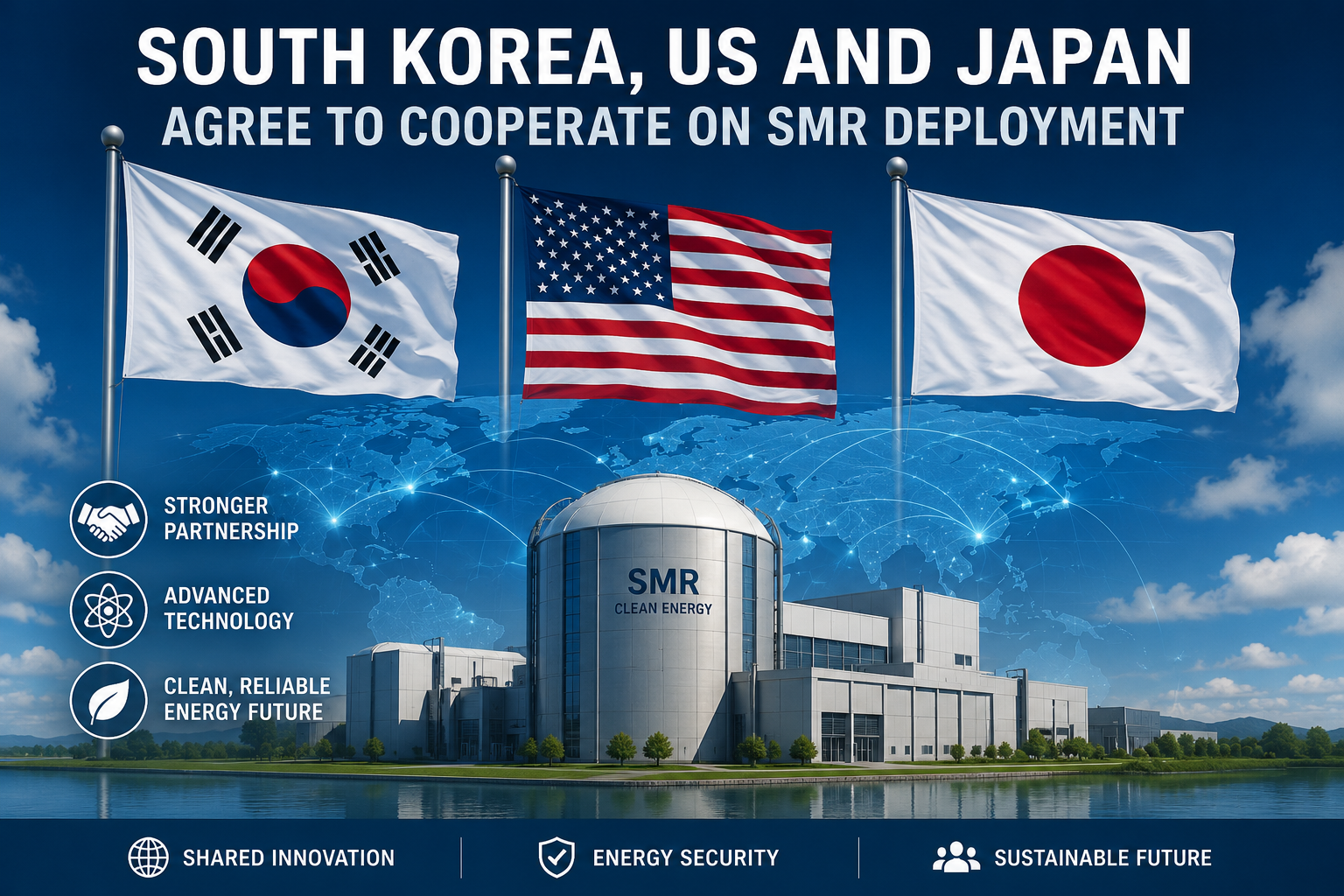
US-Japan-Korea SMR Agreement: What the Trilateral Deal Means for Vendors and Utilities
US, Japan and South Korea Sign SMR Cooperation Deal — What It Means Beyond the Headline
On July 7, 2026, on the margins of the NATO Summit in Ankara, the United States, Japan, and South Korea signed a memorandum of cooperation on small modular reactor (SMR) deployment. US Secretary of State Marco Rubio, Japan’s Foreign Minister Motegi Toshimitsu, and South Korea’s Foreign Minister Cho Hyun signed for their respective governments. The news itself has been reported widely — World Nuclear News broke the story, and the US Department of State published its own release.
What matters more to anyone tracking SMR project economics — utilities, EPC firms, municipal planners, and component suppliers — is what the memorandum actually commits its three signatories to do, and how it fits into a pattern that’s been building for several years. That’s the analysis this page focuses on.
What the memorandum actually says
The agreement is not a construction contract or a financing commitment. It’s a government-to-government framework with three concrete elements:
- Third-country identification. The US, Japan, and South Korea will jointly identify countries in the Indo-Pacific region interested in SMR deployment, then support construction of multiple units through a standardized fleet approach and simplified contracting.
- Consortium encouragement. The three governments will encourage their domestic nuclear industries to form consortiums rather than compete bilaterally for the same third-country contracts — a shift from the country-vs-country SMR sales competition that has characterized the last several years.
- New FIRST program funding. The US State Department committed more than $10 million in new funding to its Foundational Infrastructure for Responsible Use of Small Modular Reactor Technology (FIRST) program, aimed at technical assistance and a new SMR Regional Training Hub for workforce development in the Indo-Pacific.
The FIRST program itself isn’t new — it launched in 2021 with an initial $5.3 million commitment and already supports SMR feasibility work in Poland, Ukraine, Kenya, Romania, Indonesia, and Brazil, per the State Department’s program history. The July 2026 announcement roughly doubles the original US investment and narrows the near-term geographic focus to the Indo-Pacific.
The industry initiative bundled into the announcement
Separately from the government memorandum, the State Department also announced an industry-side initiative among GE Vernova (USA), Hitachi (Japan), Samsung C&T (South Korea), and SGE (Poland) to coordinate BWRX-300 deployment across Europe. This is worth separating from the trilateral MOU because it’s a commercial arrangement between named companies, not a government commitment — and because it signals where the BWRX-300 supply chain is actually furthest along.
Two data points anchor how far along that supply chain is:
- Darlington, Ontario (Canada): Ontario Power Generation’s BWRX-300 — the reference unit for the design — received its construction licence from the Canadian Nuclear Safety Commission in April 2025. The first module (a steel-and-concrete basemat) was set in place on May 1, 2026, and the unit is targeting commercial operation in 2030, per CNSC’s project page and OPG’s own project updates.
- United Kingdom: SGE, alongside Samsung C&T, Laing O’Rourke, Aecon Group, and Google Cloud, filed a 1,500-plus-page application under the UK’s Advanced Nuclear Framework in late June 2026 to build 14 BWRX-300 units across three sites — 4.2 GW total, described as roughly 11% of current UK power demand. SGE says it has already spent an estimated £50 million (about $66 million) getting to the application stage, and is asking the UK government for site access and regulatory clarity rather than direct funding. First commercial operation is targeted for 2034. Source: World Nuclear News.
Darlington is the proof point that BWRX-300 construction methods work in practice. The UK filing is the test of whether “fleet” ordering — the same idea the trilateral MOU is trying to formalize for the Indo-Pacific — actually compresses cost and schedule the way vendors claim it will. As of this writing, no BWRX-300 unit has reached commercial operation anywhere, so every cost and schedule figure tied to the design should still be read as a target, not a track record.
What this means for vendors and suppliers
The memorandum’s stated goal — “streamline licensing processes” and “optimise supply chains” across three of the world’s most active reactor-exporting nations — is a direct signal to component and service suppliers, not just reactor vendors. A coordinated US-Japan-Korea approach to third-country SMR deals typically means:
- Shared qualification standards. If the three countries move toward common licensing and contracting templates for export projects, suppliers currently qualified under one country’s nuclear QA program (10 CFR 50 Appendix B in the US, for example) may find that credential carries more weight across all three markets, rather than requiring separate qualification per country.
- Consortium-based procurement, not single-vendor sales. The MOU explicitly encourages consortiums. That changes how a mid-tier supplier gets in the door — the entry point may increasingly be a Tier 1 EPC or reactor vendor’s existing supply chain rather than a direct government tender.
- Earlier demand signal for the Indo-Pacific. Countries flagged under this initiative haven’t been named yet. Firms with existing relationships in Southeast Asian or Pacific markets — or with electronic components, instrumentation, and controls sourcing experience relevant to nuclear-grade procurement — have a window to position before formal country selection happens.
None of this is a guarantee of contracts. Government memoranda of cooperation are diplomatic instruments, not appropriations, and history in this sector includes plenty of MOUs that didn’t convert into signed EPC contracts on the announced timeline. Treat this as a directional signal worth tracking, not a confirmed project pipeline.
What this means for project cost economics
The memorandum’s language — “de-risk project development, achieve economies of scale… streamline licensing processes, and optimise supply chains” — describes the same fleet-deployment logic behind the UK’s 14-unit SGE filing and Poland’s multi-site Orlen-SGE partnership. The theory, which is shared across nearly every SMR vendor’s public materials, holds that unit-cost premiums associated with first-of-a-kind (FOAK) construction fall as the number of standardized, repeat-built units in a fleet increases.
That theory is currently unproven at commercial scale for the BWRX-300 or any other SMR design — Darlington’s first unit hasn’t reached completion yet, so there’s no delivered cost data to confirm or refute the fleet-savings claim. Anyone modeling SMR project costs today should treat vendor fleet-economics projections as planning assumptions, not confirmed figures, and should separate government policy announcements (which affect financing access and licensing speed) from construction cost data (which is still mostly pre-completion estimates).
Key facts at a glance
| Item | Detail | Source |
|---|---|---|
| Date signed | July 7, 2026, Ankara, Turkey | US State Dept. |
| Signatories | Marco Rubio (USA), Motegi Toshimitsu (Japan), Cho Hyun (South Korea) | World Nuclear News |
| New US funding | $10M+ added to the FIRST program | US State Dept. |
| Initial FIRST commitment (2021) | $5.3M | State Dept. program archive |
| Primary region of focus | Indo-Pacific (countries not yet named) | US State Dept. |
| Related industry initiative | GE Vernova, Hitachi, Samsung C&T, SGE — BWRX-300 in Europe | US State Dept. |
| BWRX-300 reference project | Darlington, Ontario — basemat placed May 1, 2026; targeting 2030 COD | CNSC, OPG |
| Largest pending BWRX-300 order | UK — 14 units / 4.2 GW proposed by SGE-led consortium, filed June 2026 | World Nuclear News |
What we don’t know yet
In keeping with the standard we hold every page on this site to: the following details have not been publicly confirmed as of July 13, 2026, and shouldn’t be treated as settled.
- Which specific Indo-Pacific countries will be named as initial targets under the memorandum.
- Whether the $10 million in new FIRST funding is a one-time appropriation or the start of a recurring commitment.
- Any binding financing terms, EPC contracts, or reactor orders resulting from the memorandum — none have been announced.
- A confirmed levelized cost of electricity (LCOE) for any completed BWRX-300 unit, since none has yet entered commercial operation.
Frequently Asked Questions
What is the US-Japan-Korea SMR memorandum of cooperation? It’s a government-to-government agreement, signed July 7, 2026, in which the US, Japan, and South Korea agree to coordinate on identifying Indo-Pacific countries interested in SMRs, encourage consortium-based bids from their nuclear industries, and fund technical assistance through the US State Department’s FIRST program.
Is this a construction contract or a funding commitment for specific reactors? No. It’s a cooperation framework. No specific reactors, sites, or countries have been named under it as of this writing. The one dollar figure attached — $10 million-plus in new FIRST program funding — pays for technical assistance and workforce training, not reactor construction.
How does this relate to the BWRX-300 projects in Canada, Poland, and the UK? Those are separate, further-along commercial projects using the same reactor design (GE Vernova Hitachi’s BWRX-300). The State Department bundled an industry coordination announcement involving the same companies (GE Vernova, Hitachi, Samsung C&T, SGE) into the same news cycle, but it’s a distinct, company-level initiative focused on Europe, not the Indo-Pacific-focused government MOU.
What should SMR suppliers and EPC firms do with this information? Track which countries get named under the initiative, monitor whether shared licensing or qualification standards materialize between the three countries, and treat consortium participation — rather than direct government tenders — as the likely path into these projects. For background on how SMR supplier qualification generally works, see our SMR vendor and supplier guide.
Related reading on SMR Facility
- SMR Siting Requirements
- SMR Power Plant Cost Breakdown
- SMR Facilities Project Tracker
- SMR Vendor & Supplier Guide
This is independent analysis and is not affiliated with the US Department of State, World Nuclear Association, GE Vernova, or any company named above. Figures and dates are sourced as cited; where a figure could not be independently confirmed, it has been flagged rather than estimated.