
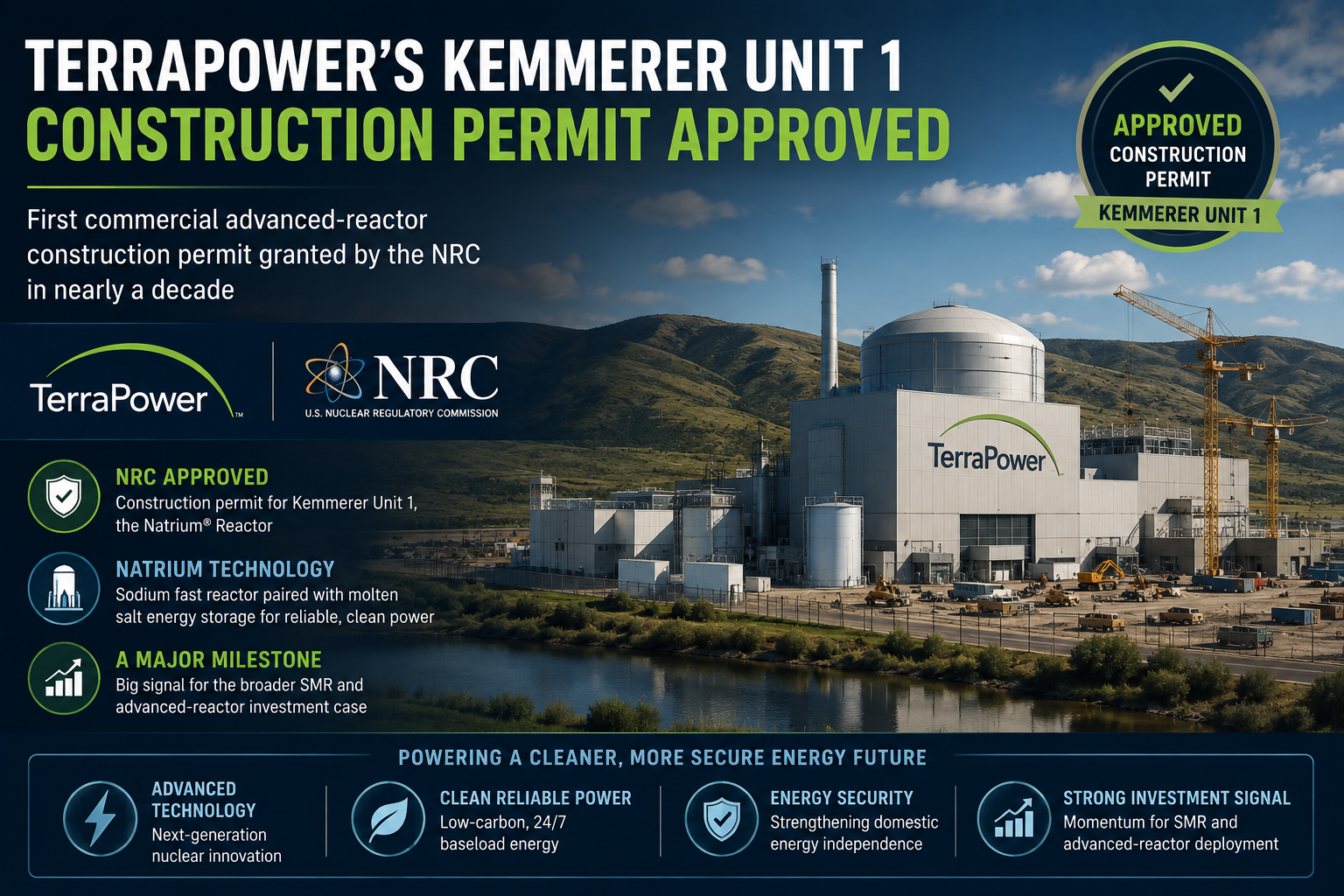
NRC Approves TerraPower’s Kemmerer Unit 1
NRC Approval of TerraPower Kemmerer Unit 1 is the First Commercial Advanced Reactor Construction Permit in Nearly a Decade
Updated: August 2, 2026
On March 4, 2026, the Nuclear Regulatory Commission voted to issue a construction permit for TerraPower’s Kemmerer Unit 1 — the first Natrium sodium-cooled fast reactor built for commercial power. It is the first construction permit the NRC has issued for a commercial power reactor in nearly a decade, and the first for a non-light-water reactor design in more than 40 years. Source: NRC press release 26-028
That is a regulatory milestone, not a finished plant. TerraPower still needs a separate operating license before Kemmerer Unit 1 can load fuel, and the project’s own cost estimate — $4.0 billion — has been unchanged since 2021, before construction pricing was tested against reality. This page separates what the NRC actually authorized from what’s still ahead, and lays out why utilities, EPC firms, and vendors tracking the broader SMR investment case should care about the distinction.
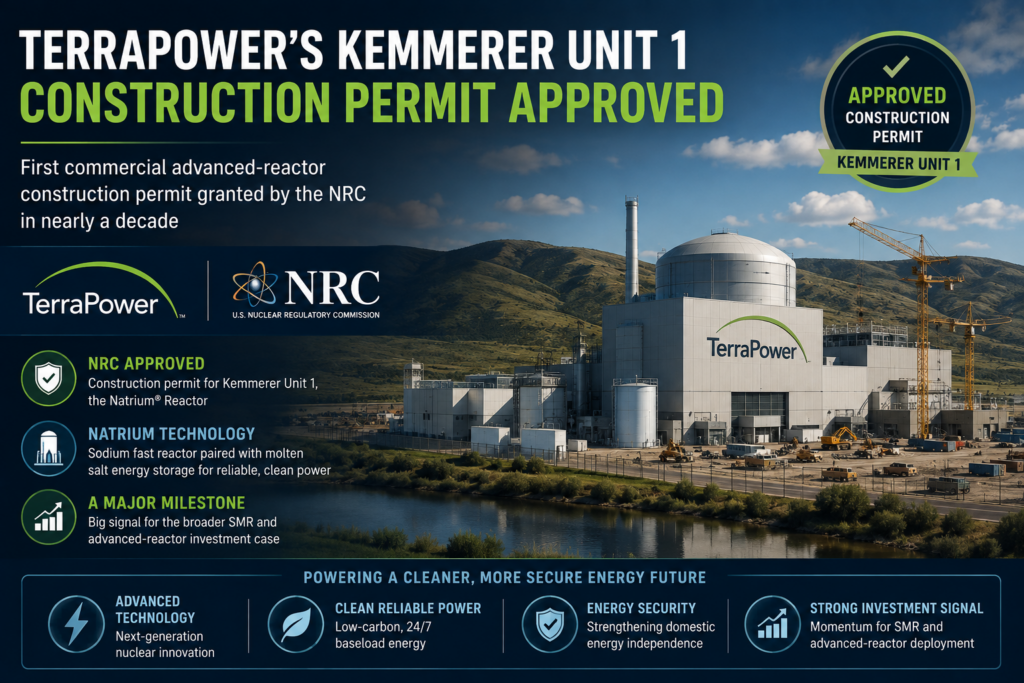
What the NRC Actually Approved
A construction permit under 10 CFR Part 50 authorizes TerraPower’s subsidiary, US SFR Owner, LLC, to begin nuclear-related construction activities at the Kemmerer, Wyoming site — pouring safety-related concrete, placing the reactor vessel and other Category I structures, and building out the plant to the design described in its application. It does not authorize fuel loading or operation. That requires a separate operating license application, which TerraPower has not yet filed. Source: DOE Office of Nuclear Energy
TerraPower used the traditional two-step Part 50 licensing path (construction permit, then operating license) rather than the combined construction-and-operating license (COL) process used for most recent light-water reactor projects. That’s typical for first-of-a-kind, non-light-water designs, where the NRC and applicant both want a design-review checkpoint before pouring concrete, rather than approving construction and operation in a single combined license.
Why “nearly a decade” and “40 years” are the right benchmarks
- The NRC’s own announcement frames this as the first commercial reactor construction permit approval in close to ten years — the most recent comparable commercial construction activity being the Vogtle Units 3 and 4 combined licenses, which trace back further. Source: NRC
- It’s also the first time since the early 1980s that the NRC has docketed and approved an application for a commercial non-light-water power reactor — meaning a design that doesn’t use ordinary water as both coolant and moderator. Natrium uses liquid sodium as primary coolant, which behaves very differently from water at both regulatory and engineering levels, and had no modern review precedent inside the NRC. Source: World Nuclear News
The Review Timeline
TerraPower submitted the Kemmerer Unit 1 construction permit application in March 2024. The NRC docketed it in May 2024 — itself notable, since it marked the first time in over 40 years the agency had accepted an application for a commercial non-light-water reactor for review. Source: NRC
The technical review took less than 18 months, with the NRC issuing its final safety evaluation report on December 1, 2025 — about eight months ahead of the agency’s own original schedule. The Commission’s construction permit vote followed on March 4, 2026. Source: NRC
TerraPower began nuclear-related construction activities at the Kemmerer site in April 2026, following the permit vote. Source: American Nuclear Society / Nuclear Newswire
An accelerated technical review is a genuine signal about NRC capacity and process maturity for advanced reactor designs. It is not, by itself, evidence about construction cost or schedule risk — those are separate variables this page tracks separately below.
What the Natrium Design Actually Is
The Natrium reactor is a 345-megawatt-electric sodium-cooled fast reactor paired with a molten salt thermal energy storage system. The storage system can boost output to 500 MWe for several hours at a time, letting the plant flex output to match grid demand or firm intermittent renewable generation — a feature distinct from most conventional baseload nuclear designs. Source: DOE Office of Nuclear Energy
Natrium was co-developed by TerraPower and GE Hitachi Nuclear Energy. The Kemmerer site sits adjacent to PacifiCorp’s retiring Naughton coal-fired power plant — part of a deliberate siting strategy to reuse existing grid interconnection and workforce infrastructure at a retiring coal site, rather than build on greenfield land.
The Money Behind It
TerraPower’s own project cost estimate for Kemmerer Unit 1 is $4.0 billion, a figure the company has held since 2021 — before this construction phase began and before current labor and materials pricing could be tested against it. That estimate should be read as a planning figure, not a confirmed final cost, and this page will update if TerraPower discloses a revised number. Source: SeQH Research construction cost tracker
Funding is split roughly between public and private sources:
- Roughly $2 billion in DOE cost-share support, tied to the Advanced Reactor Demonstration Program that selected Natrium as one of two initial demonstration awardees in 2020.
- More than $1.4 billion in private capital, including a $650 million raise in 2025 that drew in Nvidia’s venture arm (NVentures) alongside continued backing from Bill Gates and South Korea’s HD Hyundai. Source: TechCrunch
Bill Gates founded TerraPower and remains its chairman and largest individual backer. That detail matters for E-E-A-T purposes on this topic because Gates’s continued personal involvement — and repeat institutional and hyperscaler capital, not just government support — is one of the concrete signals distinguishing Natrium from earlier advanced-reactor demonstration projects that struggled to raise private follow-on funding.
Kemmerer Unit 1 is targeting completion in 2030, which would make it the first utility-scale advanced (non-light-water) nuclear power plant to come online in the United States. Source: TerraPower
Why This Is a Signal for the Broader SMR Investment Case
Kemmerer’s construction permit lands in the middle of a much larger wave of advanced reactor activity, and it functions as a proof point for that wider market in a specific, narrow way: it shows the NRC can complete a non-light-water reactor technical review faster than its own original schedule, using a real commercial applicant rather than a research reactor or federal test facility.
That matters to other developers and their investors because NRC review timeline risk has historically been one of the hardest variables to underwrite in advanced reactor project finance. A few adjacent data points show why the timing lands the way it does:
- Oklo — developing a sodium-cooled fast microreactor design, with a market capitalization in the low double-digit billions as of mid-2026 — is one of several developers participating in the DOE’s Reactor Pilot Program, which has set a goal of at least three advanced reactors achieving criticality by July 4, 2026. Source: Yahoo Finance
- X-energy completed a Nasdaq IPO in April 2026, raising roughly $1.02 billion at $23 per share — reported as the largest advanced-nuclear IPO to date. Source: IPO Club / smrintel.com
- Kairos Power broke ground on its larger Hermes 2 reactor in April 2026 and holds a fleet deal with Google for 500 MW of future SMR capacity — one of several corporate offtake commitments from hyperscalers now exceeding a combined 10 GW. Source: smrintel.com
None of these companies’ timelines or valuations are guaranteed by TerraPower’s permit — each design, site, and applicant goes through its own independent NRC review. But a completed, faster-than-scheduled review of the hardest case (a genuinely new coolant technology, not a light-water variant) gives every other advanced reactor applicant a real data point to cite when investors or utility boards ask how long NRC review actually takes in 2026, rather than relying on decades-old precedent from a very different regulatory era.
What We Don’t Know Yet
Consistent with the standard this site holds every page to: the following has not been publicly confirmed as of August 2, 2026, and shouldn’t be treated as settled.
- Actual construction cost. The $4.0 billion estimate is unchanged since 2021. No independently audited, current-dollar cost figure has been published since construction activities began in April 2026.
- Operating license timeline. TerraPower has not yet filed its operating license application, and no date for that filing has been publicly disclosed. Fuel loading and operation cannot proceed without it.
- Whether the 2030 completion target holds. First-of-a-kind nuclear construction schedules have a well-documented history of slipping; this page will track and update if TerraPower or the NRC discloses schedule changes.
- Full public disclosure of DOE cost-share terms. The roughly $2 billion figure is reported by multiple outlets but TerraPower has not published the complete cost-share agreement terms on its own site as of this writing.
Key Facts at a Glance
| Item | Detail | Source |
|---|---|---|
| Permit type | 10 CFR Part 50 construction permit (not a combined license) | NRC |
| Permit vote date | March 4, 2026 | NRC |
| Applicant | US SFR Owner, LLC (TerraPower subsidiary) | NRC |
| Site | Kemmerer, Wyoming, adjacent to PacifiCorp’s retiring Naughton coal plant | TerraPower |
| Reactor type | Sodium-cooled fast reactor + molten salt thermal storage | DOE |
| Output | 345 MWe baseload, boostable to 500 MWe via storage | DOE |
| Application submitted | March 2024 | NRC |
| Docketed | May 2024 (first non-LWR commercial docket in 40+ years) | NRC |
| Final safety evaluation | December 1, 2025 (~8 months ahead of schedule) | NRC |
| Construction start | April 2026 | ANS Nuclear Newswire |
| Cost estimate | $4.0 billion (unchanged since 2021) | SeQH Research |
| DOE cost-share | ~$2 billion (Advanced Reactor Demonstration Program) | DOE |
| Private capital raised | $1.4B+ total, incl. $650M 2025 round (Nvidia, Gates, HD Hyundai) | TechCrunch |
| Target completion | 2030 | TerraPower |
| Co-developer | GE Hitachi Nuclear Energy | DOE, TerraPower |
Frequently Asked Questions
Did the NRC approve TerraPower to start operating a nuclear reactor? No. The NRC issued a construction permit, which authorizes building the plant. TerraPower must file and receive a separate operating license before it can load fuel or generate power.
Why is this called the first advanced reactor construction permit in nearly a decade? Because it’s the first construction permit the NRC has issued for a new commercial power reactor in roughly that timeframe, and the first for a non-light-water design (one that doesn’t use ordinary water as coolant) in over 40 years.
What is a Natrium reactor? A 345 MWe sodium-cooled fast reactor developed by TerraPower and GE Hitachi Nuclear Energy, paired with a molten salt energy storage system that can temporarily boost output to 500 MWe.
How much does the Kemmerer Unit 1 project cost? TerraPower’s stated estimate is $4.0 billion, a figure unchanged since 2021. No updated, audited cost figure has been published since construction began in April 2026.
Who is funding the project? Roughly $2 billion in DOE cost-share support plus more than $1.4 billion in private capital, including investment from Bill Gates, Nvidia’s venture arm, and HD Hyundai.
When will Kemmerer Unit 1 start generating power? TerraPower is targeting 2030 for completion, but that is a company target, not a regulatory commitment, and first-of-a-kind nuclear construction schedules commonly slip.